After returning from an adrenalin-pumping dive on a seamount between Sucia and Patos Islands last year, my good dive buddy Jon got out his charts and starting looking for similar locations in the Strait of Georgia. He found what looked like a series of seamounts immediately off the northeast point of Saturna Island, just northwest of Patos. We put this area on our list of “need to dive” sites, but wanted to make certain we got good tides and weather before heading into the mighty Strait of George and giving it a try. Those conditions finally aligned for us this Saturday.
Saturday morning I hit the road at 6:30 AM for yet another San Juan Island diving day marathon. After driving for 2 hours, launching the boat and cruising for another 90 minutes, we arrived in the “Toolbox” at Saturna Island around 10:30 AM. The reef on the northeast side of Saturna Island is aptly named Boiling Reef as it was awash in current, even though the current predictions for the day called for a gentle ebb. However, the south side of the large, exposed rock in the middle of the reef was in the lee of the current. As we slowly approached the south side of the rock, the depth sounder revealed an extensive wall that towered over 150 feet in places. Perfect! With high expectations, Jon and I suited up and jumped in on the southwest side of the reef next to a colony of Caspian gulls, leaving the colony of stellar sea lion at the other end of the rock in peace. We were greeted by a somewhat unspectacular wall with some interesting invertebrates and relatively sparse fish stocks. Most notable were stunning colonies of rather large zoanthids clinging to the underside of some of the ledges. This wasn’t a bad dive, but it just wasn’t worth the investment to get here.
Saturday morning I hit the road at 6:30 AM for yet another San Juan Island diving day marathon. After driving for 2 hours, launching the boat and cruising for another 90 minutes, we arrived in the “Toolbox” at Saturna Island around 10:30 AM. The reef on the northeast side of Saturna Island is aptly named Boiling Reef as it was awash in current, even though the current predictions for the day called for a gentle ebb. However, the south side of the large, exposed rock in the middle of the reef was in the lee of the current. As we slowly approached the south side of the rock, the depth sounder revealed an extensive wall that towered over 150 feet in places. Perfect! With high expectations, Jon and I suited up and jumped in on the southwest side of the reef next to a colony of Caspian gulls, leaving the colony of stellar sea lion at the other end of the rock in peace. We were greeted by a somewhat unspectacular wall with some interesting invertebrates and relatively sparse fish stocks. Most notable were stunning colonies of rather large zoanthids clinging to the underside of some of the ledges. This wasn’t a bad dive, but it just wasn’t worth the investment to get here.


©2010 Emerald Diving, All Rights Reserved
Dive Reports
Emerald Diving
Explore the coastal and inland waters of
Washington and BC
Explore the coastal and inland waters of
Washington and BC
Emerald Diving
Explore the coastal and inland waters of
Washington and BC
Explore the coastal and inland waters of
Washington and BC
Emerald Diving
Explore the coastal and inland waters of
Washington and BC
Explore the coastal and inland waters of
Washington and BC

Tumbo Channel: April 18, 2009
Jon started pouring over the charts as soon as he was back in the boat. We decided to head north to Saturna’s nearby neighbor, Tumbo Island. After scoping out a few spots on the outside of Tumbo Island that did not look promising, Jon decided that he wanted to do his second dive in the channel between Tumbo and Saturna Islands, appropriately referred to as Tumbo Channel. Things immediately started to look up as the sheer topside topography on the south side of Tumbo Island consisted of limestone formations that had been dramatically carved by weather, waves, and current. The shoreline looked very similar to Lawson Bluff at Sucia Island, which is a great dive.
The depth sounder also confirmed that the vertical topography topside continued beneath the waterline as depths plummeted to over 200 feet not 50 feet from the shoreline. What didn’t look promising was the murky dark brown water that rushed by the wall to the east at almost one mile per hour. Remembering the lesson that Hood Canal and Possession Point had taught us over the years (vis near the surface isn’t necessarily vis at depth), Jon and Tom geared up and rolled over the side of the boat. Once in the water, I started to scope out alternative dive sites on the charts near Patos Island as I half expected Jon and Tom to surface within 20 minutes and declare this site a lame duck, but it was closer to 60 minutes before they appeared about a quarter mile from the entry point. Almost before Tom could get his reg out of his mouth he exclaimed “That was a NICE dive.”
Once back in the boat, Jon and Tom dropped me on the wall about a quarter mile up-current from where I put them in. I found myself facing an unspectacular wall with poor vis. As I continued past 50 feet, the invertebrate life exploded and the vis improved to 25 feet at times. I immediately found feather stars - a species I never note in US waters. I also noted the same orange soft corals that we saw diving the seamount between Patos and Sucia Islands. Huge sections of the wall were densely packed with giant white plumose anemones while other sections were dominated by thick carpets of orange and yellow lobed ascidians (Cystodes lobatus).
The underwater topography included vertical faces and extensive boulder fields. Overhangs, caves, crevices and ledges have been cut into the soft limestone structure. Unfortunately, I got no photos from this dive as the autofocus on my Canon 450D decided to take this dive off.
After an exhilarating dive, we drifted down Tumbo Channel and BBQ’d up some brats for a late lunch. I half expected the Canadian Coast Guard to show up as we must have looked like an adrift boat on fire from the shore. We were scheduled to hit a site near Patos Island to wrap up the day’s diving, but opted to stay in Tumbo Channel for our last dives and explore the wall. Jon and I entered at the west end of the channel this time - it was not quite as prolific, but still outstanding. Vis was quite a bit better too, being over 30 feet at times.
We were greeted by a large, scattered pod of Dahl’s porpoises north of Orcas on the way home. We rolled into Washington Park around 7:30 PM and arrived home by 9:45 PM. Another long day of San Juan - actually Gulf Island diving, but well worth it as we found one of the best sites any of us has had the privilege of diving in the Northwest. And once again, Mother Nature showed us that, good or bad, things are often not as they appear on the surface. Sometimes you just have to jump in and take a look.
The depth sounder also confirmed that the vertical topography topside continued beneath the waterline as depths plummeted to over 200 feet not 50 feet from the shoreline. What didn’t look promising was the murky dark brown water that rushed by the wall to the east at almost one mile per hour. Remembering the lesson that Hood Canal and Possession Point had taught us over the years (vis near the surface isn’t necessarily vis at depth), Jon and Tom geared up and rolled over the side of the boat. Once in the water, I started to scope out alternative dive sites on the charts near Patos Island as I half expected Jon and Tom to surface within 20 minutes and declare this site a lame duck, but it was closer to 60 minutes before they appeared about a quarter mile from the entry point. Almost before Tom could get his reg out of his mouth he exclaimed “That was a NICE dive.”
Once back in the boat, Jon and Tom dropped me on the wall about a quarter mile up-current from where I put them in. I found myself facing an unspectacular wall with poor vis. As I continued past 50 feet, the invertebrate life exploded and the vis improved to 25 feet at times. I immediately found feather stars - a species I never note in US waters. I also noted the same orange soft corals that we saw diving the seamount between Patos and Sucia Islands. Huge sections of the wall were densely packed with giant white plumose anemones while other sections were dominated by thick carpets of orange and yellow lobed ascidians (Cystodes lobatus).
The underwater topography included vertical faces and extensive boulder fields. Overhangs, caves, crevices and ledges have been cut into the soft limestone structure. Unfortunately, I got no photos from this dive as the autofocus on my Canon 450D decided to take this dive off.
After an exhilarating dive, we drifted down Tumbo Channel and BBQ’d up some brats for a late lunch. I half expected the Canadian Coast Guard to show up as we must have looked like an adrift boat on fire from the shore. We were scheduled to hit a site near Patos Island to wrap up the day’s diving, but opted to stay in Tumbo Channel for our last dives and explore the wall. Jon and I entered at the west end of the channel this time - it was not quite as prolific, but still outstanding. Vis was quite a bit better too, being over 30 feet at times.
We were greeted by a large, scattered pod of Dahl’s porpoises north of Orcas on the way home. We rolled into Washington Park around 7:30 PM and arrived home by 9:45 PM. Another long day of San Juan - actually Gulf Island diving, but well worth it as we found one of the best sites any of us has had the privilege of diving in the Northwest. And once again, Mother Nature showed us that, good or bad, things are often not as they appear on the surface. Sometimes you just have to jump in and take a look.
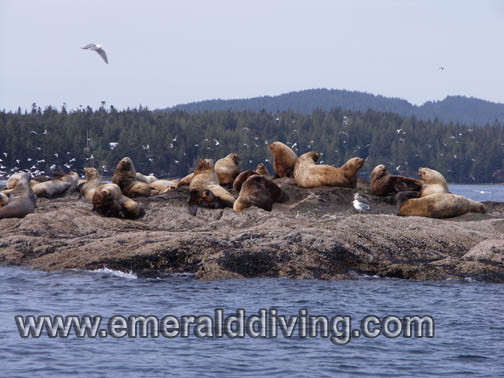
Everything is bigger in Canada, especially taxes and marine life. These are Canadian sea otters - OK, they are actually a colony of well behaved stellar sealions that inhabit the rocks at Boiling Reef.
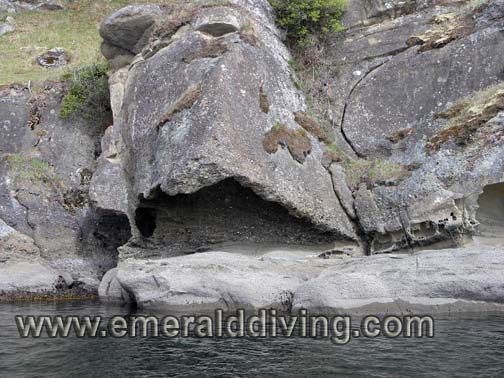
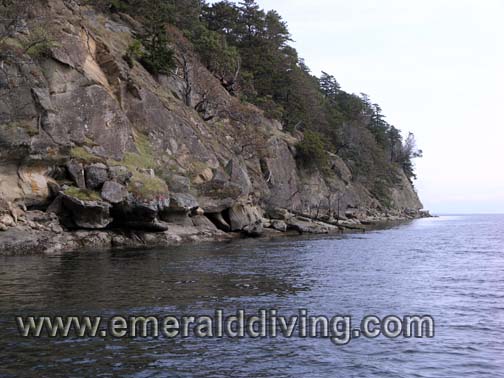
What you see above the water is what you get below the water in Tumbo Channel. Top pic looks east to the end of the south side of Tumbo Island.

Incredible carpets of large zoanthids graced the underside of some of the overhangs at Boiling Reef.
Pacifc blue mussels - Duncan Rock
The mussels are over 8" in length!
The mussels are over 8" in length!

A HUGE white lined dirona cruises the rocks at Boiling Reef. This animal was as big as my fist.

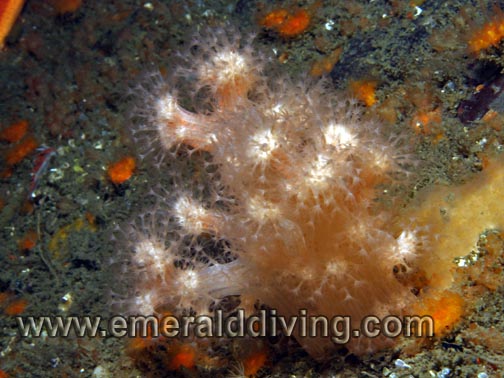
Orange soft corals - an invertebrate species that we just don't often see in US waters.
The well camouflaged golfball or rhinocerus crab. I readily found these unique lithoid crabs on several section of the wall in Tumbo Channel.
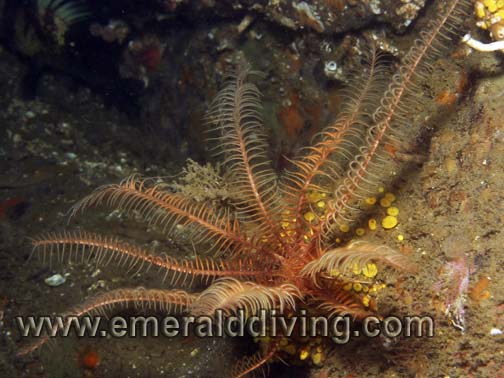
The business end of a feather star - not the place to end up after a long drift if you are planktonic in nature.

The fern-like feather star was readily abundant along Tumbo Channel wall.
After returning from an adrenalin-pumping dive on a seamount between Sucia and Patos Islands last year, my good dive buddy Jon got out his charts and starting looking for similar locations in the Strait of Georgia. He found what looked like a series of seamounts immediately off the northeast point of Saturna Island, just northwest of Patos. We put this area on our list of “need to dive” sites, but wanted to make certain we got good tides and weather before heading into the mighty Strait of George and giving it a try. Those conditions finally aligned for us this Saturday.
Saturday morning I hit the road at 6:30 AM for yet another San Juan Island diving day marathon. After driving for 2 hours, launching the boat and cruising for another 90 minutes, we arrived in the “Toolbox” at Saturna Island around 10:30 AM. The reef on the northeast side of Saturna Island is aptly named Boiling Reef as it was awash in current, even though the current predictions for the day called for a gentle ebb. However, the south side of the large, exposed rock in the middle of the reef was in the lee of the current. As we slowly approached the south side of the rock, the depth sounder revealed an extensive wall that towered over 150 feet in places. Perfect! With high expectations, Jon and I suited up and jumped in on the southwest side of the reef next to a colony of Caspian gulls, leaving the colony of stellar sea lion at the other end of the rock in peace. We were greeted by a somewhat unspectacular wall with some interesting invertebrates and relatively sparse fish stocks. Most notable were stunning colonies of rather large zoanthids clinging to the underside of some of the ledges. This wasn’t a bad dive, but it just wasn’t worth the investment to get here.
Saturday morning I hit the road at 6:30 AM for yet another San Juan Island diving day marathon. After driving for 2 hours, launching the boat and cruising for another 90 minutes, we arrived in the “Toolbox” at Saturna Island around 10:30 AM. The reef on the northeast side of Saturna Island is aptly named Boiling Reef as it was awash in current, even though the current predictions for the day called for a gentle ebb. However, the south side of the large, exposed rock in the middle of the reef was in the lee of the current. As we slowly approached the south side of the rock, the depth sounder revealed an extensive wall that towered over 150 feet in places. Perfect! With high expectations, Jon and I suited up and jumped in on the southwest side of the reef next to a colony of Caspian gulls, leaving the colony of stellar sea lion at the other end of the rock in peace. We were greeted by a somewhat unspectacular wall with some interesting invertebrates and relatively sparse fish stocks. Most notable were stunning colonies of rather large zoanthids clinging to the underside of some of the ledges. This wasn’t a bad dive, but it just wasn’t worth the investment to get here.